You're scrolling TikTok late at night, half laughing, half confused, and another caption pops up: “POV: you're trying to leave work on a Friday.” You understand the vibe. You probably even relate. But if you've ever paused and thought, “Wait, what does POV mean on TikTok?” you're not alone.
The short answer is simple. POV means point of view. The useful answer is more interesting. On TikTok, POV isn't just an acronym. It's a storytelling device, a hook format, and a fast way to make viewers feel like they're inside the joke, the drama, or the scenario.
If you want to understand the pov meaning in tiktok, and use it well, you need more than a dictionary definition. You need to know how creators frame a POV, why people stop scrolling for it, and how to turn it into content that people watch, share, and respond to.
It usually starts like this. You open TikTok for “five minutes,” then your For You Page serves up one POV after another. “POV: you're the friend who always arrives early.” “POV: your cat hears the treat bag.” “POV: you just sent a risky text.” Different topics, same setup.
That repetition isn't random. POV became one of TikTok's signature ways to package an idea into a quick, emotionally clear scene. The caption does heavy lifting right away. It gives context before the action starts, which is one reason the format fits the speed of short form video so well.
If you're also trying to understand how content gets pushed to more viewers, this guide to mastering TikTok's For You Page is worth reading alongside TikTok's own behavior patterns. For a broader breakdown of recommendation signals, the article on how the TikTok algorithm works helps connect the format to distribution.
POV works because it tells viewers how to watch the video before the scene even begins.
A lot of new creators think POV is niche slang. It's not. It's one of the clearest examples of how TikTok turns a simple label into a whole content language.
In plain English, POV means “point of view.” In film, that usually means the camera shows what a character sees. On TikTok, the meaning stretches a bit. Sometimes the camera acts like your eyes. Other times the text creates the perspective, and the creator performs the scene for you.
Think of a TikTok POV like a mini movie prompt.
The text says, “POV: you're the substitute teacher trying to get the class under control.” Instantly, the viewer knows the role, the setting, and the tone. The creator doesn't need a long setup. The scenario is the setup.
That's the key difference people miss. On TikTok, POV often functions less like strict cinematography and more like an invitation. The viewer is being placed into a situation.
The format didn't stay small for long. According to Mandala System's writeup on the POV trend, the #POV hashtag on TikTok has amassed over 739 billion views, and the trend's origin is credited to TikTok creator Amy Ang (@amyy.ang), who began posting POV videos in 2019.
That scale matters because it shows POV isn't a side trend. It became one of the platform's default storytelling patterns.
Here's the easiest way to understand the pov meaning in tiktok:
| What people think POV means | What it often means on TikTok |
| A literal first-person camera shot | A scenario that puts the viewer into a role |
| A filming technique | A hook plus a performance format |
| A niche trend | A mainstream content language |
A good POV video usually gives you three things in seconds:
That's why POV feels personal even when the creator is acting alone on screen. The text makes the audience part of the scene.
Once you understand the basic pov meaning in tiktok, the next surprise is how flexible it is. POV isn't one style. It's a container. Creators use that container for comedy, storytelling, education, niche jokes, and soft selling.
This is the version that many viewers recognize first. It takes a common experience and exaggerates it just enough to make it funny.
Examples:
These work well because viewers instantly know the feeling. No explanation needed.
Some creators use POV like a tiny scene from a larger story. These videos feel more theatrical and often rely on facial expression, timing, and character acting.
Examples:
This version is great if you like roleplay, acting, or character based content.
The stronger the scenario, the less you need fancy production.
These videos let viewers step into a desired moment. They're less about a joke and more about mood, identity, or “that could be me.”
Examples:
Lifestyle creators often use this style to make routines feel immersive instead of instructional.
The format gets really useful for creators, brands, and small businesses. You can take an insider moment from your niche and turn it into an instantly readable scene.
Examples:
For more prompts designed for different content styles, this list of TikTok content ideas for creators can help you translate daily experiences into actual posts.
A quick way to choose:
You don't need to do all of them. You need the one that sounds like you.
Making a POV video that people watch through is less about luck and more about structure. TikTok rewards clarity. Viewers reward relevance. POV works best when your idea is obvious fast, performed cleanly, and packaged in a way that invites interaction.
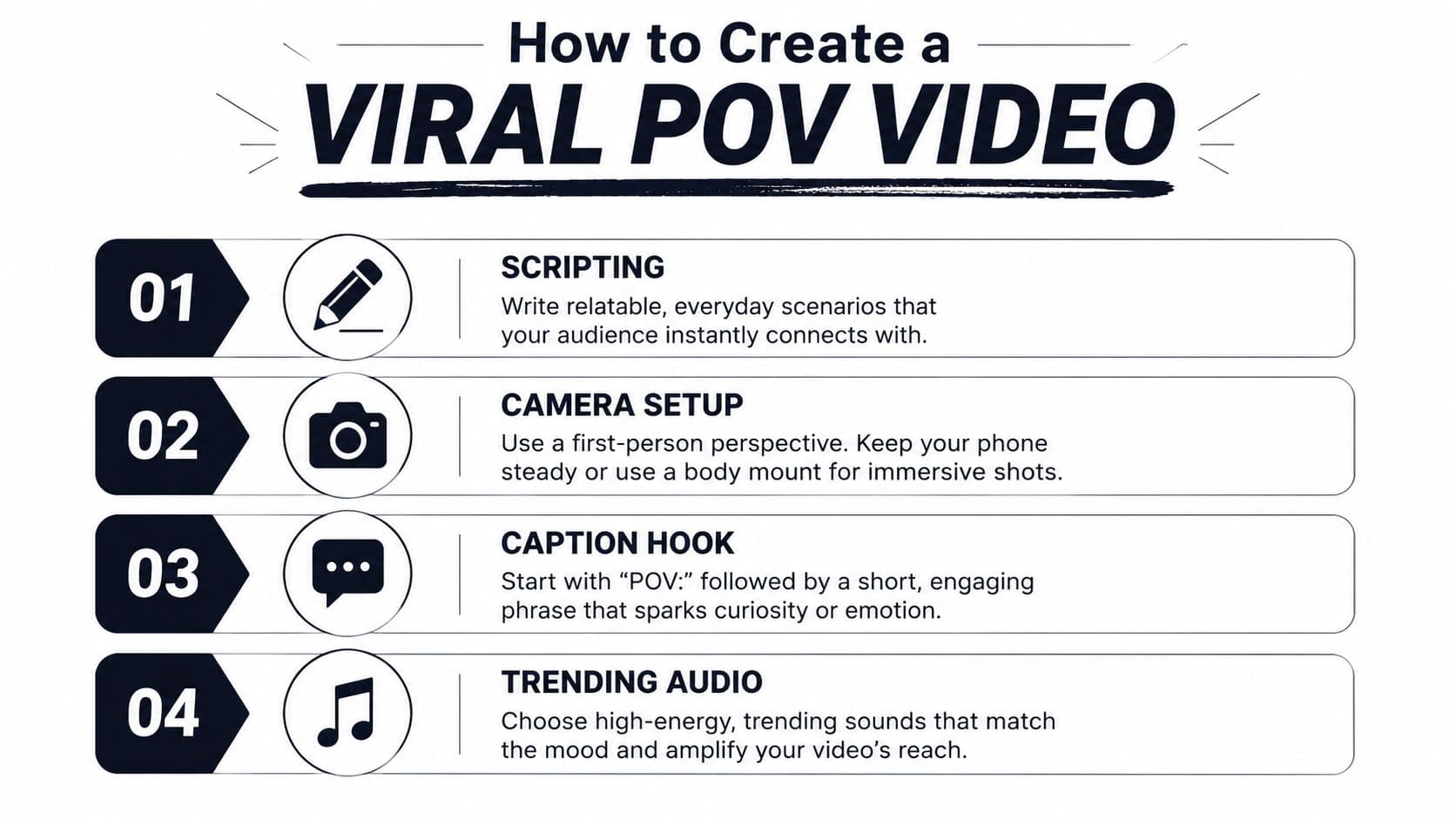
According to AmazingTalker's summary of POV performance signals, POV content on TikTok functions as a performative storytelling prompt, leading to 35% increased duet/stitch participation rates and 28% higher watch time. The same source says top-performing POV videos often use a 9:16 aspect ratio, run for 15 to 30 seconds, and use front-facing camera angles, with this setup associated with a 1.5x higher FYP placement probability.
Your text overlay matters as much as your filming.
Bad hook:
Better hook:
The stronger version gives a sharper situation. It creates tension right away.
Try these hook patterns:
You don't need cinema gear. You need intention.
Use vertical framing. Keep the shot clean. Make sure the face, hands, or key action are easy to read on a phone screen. If you're doing a direct viewer scenario, the front-facing camera often feels more personal. If you're acting a scene, commit to the expression and pacing.
Practical rule: If someone can't understand the scenario in the first moments, the POV probably needs rewriting.
After filming, finish the package. Add a caption that supports the scenario without repeating it word for word. Use hashtags sparingly and relevantly. If a voiceover strengthens the joke or setup, use one. If you need help recording cleaner narration, this guide to doing voiceovers on TikTok is a useful walkthrough.
Audio selection matters too. A trending sound can make a simple POV feel current. If you also create for Instagram, trend spotting across formats helps, especially with emotional or milestone content. This roundup of heartfelt Reel audio for anniversaries shows how sound choice changes tone fast.
A few mistakes show up again and again:
Treat POV like a short scene, not a diary entry. Clarity wins.
Knowing what POV means is one skill. Knowing which POV to post this week is a different one.
That's the hard part for most creators. You can understand the format perfectly and still freeze when it's time to choose the angle, the hook, the sound, and the timing. That's where tools built for trend discovery become useful.

According to Dictionary.com's overview of TikTok slang and format evolution, POV rose during the period when TikTok's user base grew from 500 million in mid-2019 to over 1 billion by 2021, and first-person videos like these showed 2 to 3x higher completion rates and duet participation than standard posts. That context explains why AI based trend tools pay close attention to formats like POV.
A POV can fail for a simple reason. It's the wrong scenario at the wrong moment.
One week, viewers want chaotic workplace humor. Another week, they respond to soft lifestyle storytelling. A broad idea like “make a POV video” doesn't solve that. Creators need signals about what's rising in their niche, what audio pairs well with that format, and what hook style fits their audience.
That's why feature sets like the ones outlined in Trendy's platform overview are useful to study. The biggest advantage isn't just seeing trends. It's narrowing them to the ones that fit your category and current content style.
If you're comparing tools or building your workflow, prioritize these capabilities:
A tool should shorten the distance between “I need to post” and “I know exactly what to make.”
Here's a quick look at the kind of workflow creators want:
| Creator problem | Helpful platform feature |
| I don't know which POV angle fits my niche | Personalized hook suggestions |
| I'm late to trends | Emerging sound and format tracking |
| I can't tell why a post worked | Performance analytics |
| I waste time planning | Weekly content organization |
A short demo helps make that more concrete:
The point isn't to automate creativity. It's to remove guesswork so you can spend more time making better videos.
The pov meaning in tiktok isn't just “point of view.” It's a fast, flexible way to turn a situation into a story people instantly understand. That's why the format keeps showing up across humor, lifestyle, education, and niche creator content.
If you remember three things, remember these. First, a POV works when the viewer immediately knows the role they're stepping into. Second, the best versions are specific, not vague. Third, strong execution comes from the full package: the hook, the performance, the pacing, and the post setup.
POV also has value beyond views. It teaches you how to write sharper scenarios, act with more intention, and build content around audience recognition. Those are useful skills in every format, not just this one.
And if your goal is turning attention into a creator business, learning adjacent skills matters too. Brand fit, audience trust, and content consistency all play a role. This guide to finding YouTube sponsorships is a solid read if you're thinking beyond views and toward monetization. For a broader publishing system, this TikTok growth strategy guide connects content formats to long term audience building.
POV isn't a chore. It's one of the cleanest creative tools TikTok gives you.
Yes. A face can help with reactions, but it isn't required. You can film your hands, your screen, your workspace, your outfit, or objects that tell the story. The important part is that the scenario is clear. If the viewer understands the role and the moment quickly, the POV can still work.
Pretty much, yes. An educator can post “POV: you finally understand the concept that confused you all semester.” A business owner can post “POV: your first customer leaves a great review.” A B2B creator can use workplace or client situations. The format is flexible because it's built around perspective, not one topic.
Specific styles inside POV will come and go. The core format is more durable than that. It fits how people consume short videos: fast context, instant recognition, and a small emotional payoff. As long as viewers keep responding to relatable scenarios, POV will keep showing up in new forms.
If you want less guesswork and more direction, Trendy helps you turn broad ideas into a real posting strategy. You can explore the platform, then download the Trendy iOS app or the Trendy Android app to get personalized trend suggestions, content ideas, and performance insights built for creators growing in 2026.